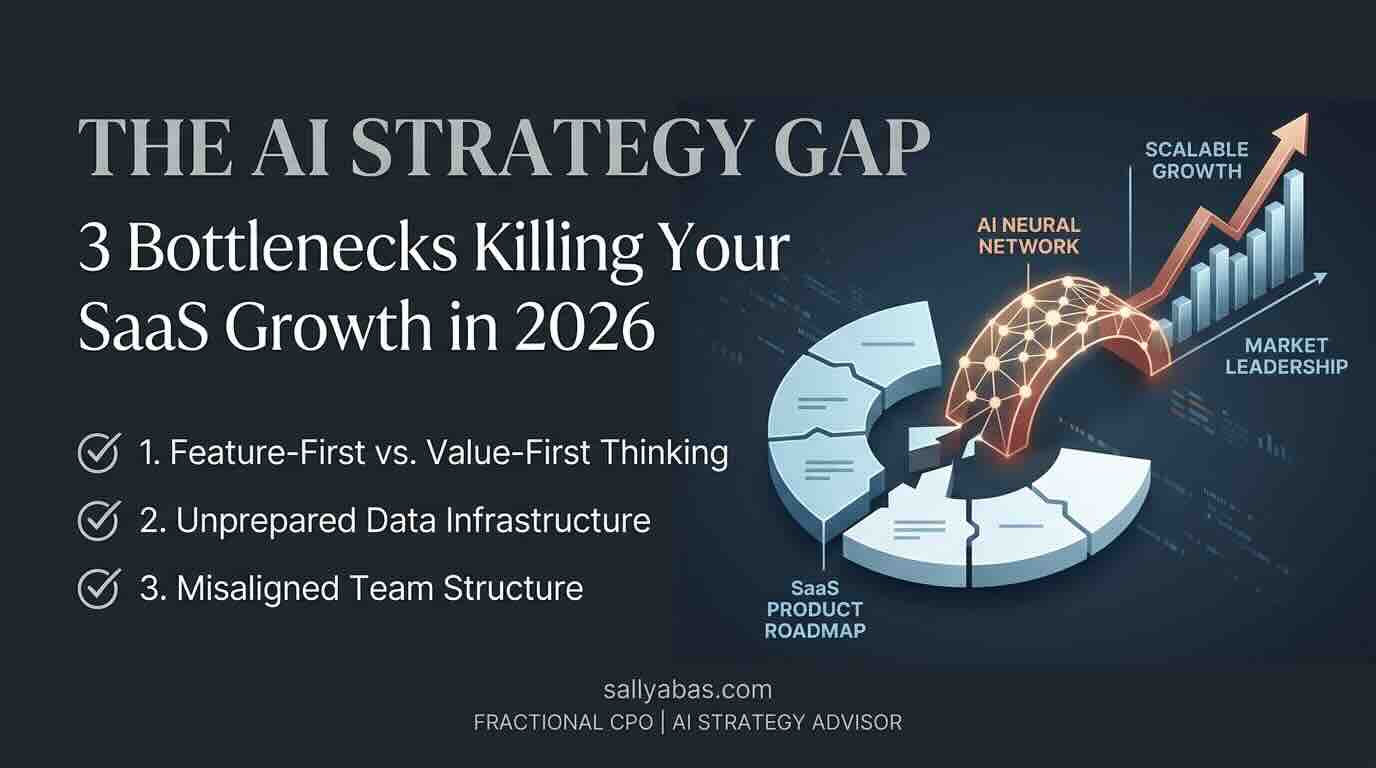
This pattern highlights a massive AI Product Strategy gap that shows no sign of slowing down across dozens of SaaS companies in the last two years, and it shows no sign of slowing down in 2026.
A founder reads about an AI capability — maybe it’s a new LLM integration, maybe it’s a predictive analytics layer, maybe it’s an AI-powered onboarding flow. They get excited. They bring it to the team. Engineering builds a version. It launches with a press release and a product update email. And then — nothing. The metrics don’t move. Users don’t engage. The feature quietly disappears from the homepage six months later.
This isn’t a technology problem. The technology worked fine.
This is an AI product strategy gap.
What the AI Product Strategy Gap Actually Looks Like
The AI product strategy gap is the space between adding an AI feature and having a coherent AI strategy.
Adding an AI feature means deploying a technology to solve a problem — or, more commonly, because a competitor did it first, or because it was discussed at a board meeting, or because an engineer built a compelling demo.
Having an AI product strategy means understanding exactly where AI creates disproportionate value in your specific product, building the infrastructure to support it reliably, and integrating AI capabilities into your core product value proposition rather than bolting them on as optional extras.
Most SaaS companies in 2026 are firmly on the “feature” side of this gap. According to research patterns I see in my work as a Fractional CPO, the majority of AI features launched without a supporting strategy don’t move the product’s core retention or engagement metrics within the first six months.
The distinction matters enormously because strategy and features require completely different organisational investments.
Moving Beyond the Hype
Let’s be direct about what is driving most AI investment decisions right now: fear of being left behind.
Founders are watching competitors launch AI features. They are reading reports about AI productivity gains. They are fielding questions from their boards about their “AI strategy.” And so they build — not because they have identified a clear AI opportunity mapped to a specific user need, but because the pressure to ship something is overwhelming.
This is not a criticism. It is the natural response to a rapidly changing market. But it produces a specific kind of waste: technically functional AI features that don’t actually improve the product experience in a way that users notice, remember, or return for.
A chatbot is not an AI strategy. A summary feature is not an AI strategy. An AI-powered dashboard widget is not an AI strategy.
An AI product strategy is a deliberate decision about which specific problems in your product ecosystem are best solved by AI, how those solutions connect to your primary value proposition, and what infrastructure you need to make them reliable and scalable.
The Three Components of a Real AI Product Strategy
After running AI strategy engagements across SaaS, fintech, e-commerce, and education products, I have identified three components that separate companies with coherent AI strategies from those chasing AI hype:
1. The Problem-First Filter
Every AI initiative should start with a specific, well-understood user problem — not with a technology. The question is not “how can we use this AI capability?” The question is “what is the most expensive, most frequent pain point in our users’ workflow, and does AI offer a 10x improvement over the current solution?”
If the answer to the second part of that question is “yes” — meaning AI genuinely offers a step-change improvement, not a marginal one — that’s a legitimate AI initiative. If the honest answer is “maybe 20% better, if it works consistently” — that’s probably not worth the investment given the added complexity.
2. The Infrastructure Reality Check
AI doesn’t run on ambition. It runs on data, compute, and engineering bandwidth. Before you can build AI that works reliably in production — not just in a demo — you need to ask three questions about your current infrastructure:
Data readiness: Is the data that your AI will learn from clean, consistent, and accessible? Or is it siloed, inconsistently formatted, or governed by three different teams with three different standards?
Feedback loops: Once the AI feature ships, how will you measure whether it’s actually working? Do you have the instrumentation in place to track AI-driven decisions and their outcomes?
Maintenance capacity: AI models degrade over time as the world changes. Who owns monitoring this? Who responds when the model starts producing wrong outputs?
If you don’t have clear answers to these three questions before you build, you are taking on hidden technical debt that will surface later — usually at the worst possible time.
3. The Competitive Moat Test
Here is the question most founders don’t ask — and should: if this AI feature works exactly as planned, does it make our product significantly harder to leave?
The most valuable AI applications are not the ones that add a new feature. They are the ones that embed AI into the core loop of how users create value in your product — so deeply that the product becomes more useful the longer someone uses it. That’s a data network effect. That’s a competitive moat.
Personalisation that improves with usage. Predictions that get more accurate as more data flows through the system. Recommendations that understand a user’s specific context in a way a competitor’s generic product never can.
These aren’t features. They are structural advantages. And they require a strategy, not just a sprint.
The Most Expensive Mistake in AI Product Strategy
If I had to identify the single most costly mistake I see SaaS founders making in their AI product strategy, it would be this: confusing the AI exploration phase with the AI execution phase.
The exploration phase is when you’re experimenting — running small proof-of-concept builds, testing user reactions, understanding the limitations of the technology. This phase should be cheap, fast, and disposable. The goal is learning, not shipping.
The execution phase is when you’ve validated that an AI application creates real user value, and you’re committing engineering resources to build it properly — with the data infrastructure, monitoring, and maintenance processes it requires.
Most companies skip the exploration phase and go straight to full execution. They build for months, discover the AI doesn’t work well enough in production, and either ship a subpar experience or kill the project entirely. Either way, they’ve spent significant resources to reach a conclusion that a three-week exploration sprint would have surfaced.
Closing the Gap: A Practical Starting Point
If you recognise the AI product strategy gap in your own organisation, here is a practical framework for closing it:
Step 1 — Map the problem landscape. Spend two weeks systematically documenting the top 10 most frequent friction points in your users’ workflows. Talk to users. Analyse support tickets. Review session recordings. Rank them by frequency and severity.
Step 2 — Apply the AI filter. For each friction point, ask: does AI offer a 10x or better improvement over the current solution? If yes, add it to the AI opportunity list. If no, solve it with simpler means.
Step 3 — Run a 3-week exploration sprint. Take the top AI opportunity and build the smallest possible version of it that lets you test the core assumption. Don’t build infrastructure yet. Just answer the question: does this actually work for real users in a real context?
Step 4 — Define success metrics before you build. Before any AI feature moves into full development, establish: what metric will prove this is working, what is the minimum acceptable performance threshold, and what is the trigger for killing the project if it doesn’t reach that threshold.
Step 5 — Build the infrastructure to support it. Only after you have validated the concept should you invest in the data infrastructure, monitoring, and maintenance processes needed for a production-quality AI feature.
The Bottom Line
In 2026, the difference between a market leader and a struggling startup isn’t the sophistication of their AI models. It is the quality of the strategy that guides where, how, and why they apply AI.
Execution is the edge. But execution without strategy is just an efficient way to build the wrong things.
If you’re currently feeling the gap — if you know AI matters but can’t pinpoint where to focus, or if your current AI initiatives aren’t producing the results you expected — the answer isn’t to add more features. The answer is to go back to strategy first.
Schedule a free strategy call to map your AI opportunities and identify which initiatives are worth pursuing — and which are consuming resources without building a real competitive advantage.
Sally Abas is a Product Strategy Consultant and Fractional CPO specialising in AI-enabled product strategy for SaaS founders and product leaders. She has scaled products across 50+ companies in 9 countries.